Miyerkules, Abril 27, 2016

Folktales in Eastern Visayas

Abadeha, Filipina Cinderella

The story of Abadeha is the Philippine version of Cinderella. Here’s how it goes.

Abadeha is a kind and hardworking young woman.  Her wicked stepmother and stepsisters abuse her and ask her to carry out impossible tasks. Abadeha asks for the help of Bathala (the creator God), her ancestors and her dead mother. At the river, her cries for help are heard by the Spirit of the Forest (counterpart of the fairy godmother). With her guidance, Abadeha is able to accomplish all that her step-family demands of her.
One day, a prince out hunting in the forest comes upon the enchanted tree by the grave of Abadeha’s mother. He sees a ring among the branches and puts it on. By the time he returns to the palace, his finger has become swollen and painful. The king calls for the Babaylan, the priest-healer of the land, but even he cannot take the ring off.
That night, the Prince learns in a dream that only a girl can remove the ring from his finger. Upon hearing this, the king announces to his people that any girl who can take the ring off his son’s finger will be offered marriage to the prince.
Of all the maidens who tried, only Abadeha was successful. And that’s how she became a princess!

The Miraculous Cow

This is a Tagalog story recorded in English in the early 20th century. This tale may strike Western sensibilities as mean, but making fun of “simple folk” is not uncommon in Filipino oral stories. It’s a moral story on cleverness contrasted with the stupidity of believing in superstition.
There was once a farmer driving home from his farm in his kariton. He had tied his cow to the back of his cart, as he was accustomed to do every evening on his way home. While he was going along the road, two boys saw him. They were Felipe and Ambrosio. Felipe whispered to Ambrosio, “Do you see the cow tied to the back of that kariton? Well, if you will untie it, I will take it to our house.”
Ambrosio approached the kariton slowly, and untied the cow. He handed the rope to Felipe, and then tied himself in the place of the animal.
“Come on, Ambrosio! Don’t be foolish! Come on with me!” whispered Felipe impatiently.
“No, leave me alone! Go home, and I will soon be there!” answered the cunning Ambrosio.
After a while the farmer happened to look back. What a surprise for him! He was frightened to find a boy instead of his cow tied to the kariton. “Why are you there? Where is my cow?” he shouted furiously. “Rascal, give me my cow!”
“Oh, don’t be angry with me!” said Ambrosio. “Wait a minute, and I will tell you my story. Once, when I was a small boy, my mother became very angry with me. She cursed me, and suddenly I was transformed into a cow; and now I am changed back into my own shape. It is not my fault that you bought me: I could not tell you not to do so, for I could not speak at the time. Now, generous farmer, please give me my freedom! for I am very anxious to see my old home again.”
The farmer did not know what to do, for he was very sorry to lose his cow. When he reached home, he told his wife the story. Now, his wife was a kind-hearted woman; so, after thinking a few minutes, she said, “Husband, what can we do? We ought to set him free. It is by the great mercy of God that he has been restored to his former self.”
So the wily boy got off. He rejoined his friend, and they had a good laugh over the two simple folks.

Legend of Eastern Visayas


The legend of mount danglay

  1. 1. The LEGEND OF MOUNT DANGLAY or “How TACLOBAN got its NAME”An Oral Tradition (usa nga Susumaton)Copyrighted by Dulce Cuna AnacionThis Tale has been passed down to me by my late Mother, Dr. Rosa Ester T. Cuna, an Englishand Literature professor of UP Tacloban College, she said this is an oral tradition shegathered from Basey, Samar, where my Father’s relatives come from.Long time ago when the island of Leyte (Tendaya island, named after a chieftain)[1] was stillsparsely uninhabited, a young couple lived in the swampy shores of Kabatok, their livelihoodwas catching crabs and shellfish and crossing the Bay to a village in Samar island (Ibabao orSibabao island, which to this day the village is named Basey), to sell in a “tabo”(market fair) inthat village everyday.[2]Dang, was a strong fisherman, he was a tall, good-looking relative of the Bornean Datu Siagu ofthe southern side of Tendaya. His body was tattooed (“patik”) all over in the tradition of histribe, he wore a loin cloth and was agile with the spear and machete he always carried withhim. His other possessions were a “bangka” (small boat) and some “taklub”(basket traps forcatching fish and crabs in shallow waters). His wife, Mulay was a weaver and basket maker. Shemade “taklub” to be sold in the Samar village during “tabo”. She was lithe, and agile too, herarms and legs were tattooed with motifs of birds and flowerets and crisscrossed with thepatterns of basket weaving.
Ballet Philippines “Tale of Bungansakit”

Myths in Eastern Visayas

Myths in Eastern Visayas

Hudhud Hi Aliguyon (The Tales of Aliguyon)

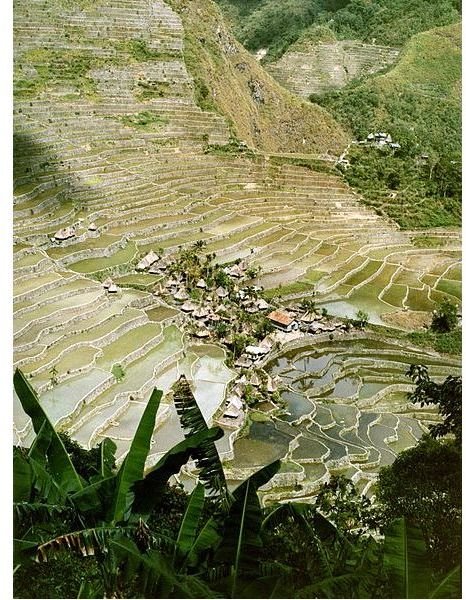
449px-Batad rice terraces
In the mountainous hinterlands of Northern Luzon, a young boy named Aliguyon was raised well by his father and he grew up to become a smart and intelligent leader. He also had the skills and prowess of a brave and stalwart warrior that children of the villages often looked up to him as a role model.
Now their tribe had a long standing feud over territorial boundaries, with another tribe in another mountain. To settle it once and for all, Aliguyon challenged the leader of the other tribe to a duel. However, the leader did not accept the challenge personally but his son, Pumbakhayon did, since he was an exact match to Aliguyon’s capabilities.
Thus, the two warriors faced each other in a battle they were not prepared for. To Aliguyon’s surprise, his adversary was as skilled and adept as he was. Accordingly, there was only one spear used because Aliguyon’s initial attempt to slay Pumbakhayon with a single but powerful thrust of his spear was not successful. Pumbakhayon was able to catch the spear and used the same weapon by throwing it to Aliguyon with an equally forceful might. The latter had no other course of action but to catch his spear and hurl it once more to his opponent.
This duel lasted for three days with nothing transpiring but the swift exchanges of hurls using only a single spear. On the third day, the two young men decided to stop the senseless exercise and agreed to talk things over. It became obvious to both of them that they were equals in every aspect despite belonging to a different tribe. They have come to respect each other’s skills and intelligence, thus realizing they are capable of settling their issues wisely. Therefore, the duel ended in a treaty and the two young men became close friends.
Their tribes and the people all lived harmoniously and peacefully. They emulated their leaders as they settled their differences by recognizing that each tribal member deserves to be accorded with respect regardless of tribe or stature.

The Story of Maria Makiling

92px-MariaMakiling Philippinefolklore
Travelers coming from Manila going to Southern Luzon will notice a mountainous mound of thick rainforests looming up ahead. The shape of the mountain takes the form of a woman lying peacefully on her back. Every home-bred Filipino can easily recognize this as Mount Makiling and the sleeping form of the woman is that of the mountain’s goddess Maria Makiling.
The mountain is actually an extinct volcano and it has relatively remained unharmed through its years of existence. Thanks to Maria Makiling’s vigilance in protecting the mountain’s ecosystem. Those who trek to the mountain are told and forewarned that Maria’s spirit often roams the woods and is capable of doing harm to those who harm any of the living creatures that live on her mountain. To the locals, she is known as a “diwata" or goddess of nature. She rewards those who heed her warnings but will severely punish those who ignore her.
A hunter tells of his experience while in pursuit of a wild boar who had tried to attack him in the deep forest of Mt. Makiling. As he was about to strike the cornered boar, a beautiful lady with golden-brown skin and long flowing black hair appeared and admonished him not to kill the wild pig. She patiently explained with a kind voice that the attack launched by the boar, was only to protect the mountain against intruders, who may one day take away all the trees in its forest.
The beautiful lady invited him to have supper with her and a place to rest for the night. The hunter felt humbled that despite being caught red-handed by Maria, she still found it in her heart to be gracious. Nevertheless, the hunter made a vow to Maria that he will no longer hunt any of the living creatures in Mt. Makiling ever again, nor take down trees from its forest.
Pleased at what she heard, Maria gave the hunter a “salakot" or buri hat filled with ginger, to take home as present for his wife. Upon reaching home, he immediately opened his back pack, to unload the heavy burden off his back. The “salakot" fell off with a heavy thud and revealed golden nuggets instead of ginger.
However, there are stories about hunters losing their way in the forest and unable to find their way back home. Others, however, were fortunate to be chanced upon by mountain climbers and hikers; albeit incoherent and unable to remember their names or where they live. The only thing they can remember is a beautiful lady who gave them food and shelter for the night.
Filipino literature is rich with myths, folklores, legends of the Philippines and the origins of the many things that can be seen, heard, felt, smelled, and tasted. There are also tales of heroism, love, compassion and promises that were fulfilled even after life. Although some stories like the legend of Maria Makiling tend to scare, they had at least, served the purpose of keeping the rainforest well-preserved with its ecology still intact.

family traditions

Filipino traditions

 Simbang Gabi. Nine dawn masses during the Christmas season. Attended by the religious, the people with panata, the uzis, and the girl and boy watchers. Of course, Simbang Gabi is not complete without the mouth-watering bibingka and puto bumbong sold outside the church.

2. Po at opo. Shows the importance and respect accorded to the elderly and the authority. Children in the Tagalog areas are taught (trained?) to say po and opo before and after every sentence.

3. Festivals. The fun-loving nature of the Pinoys is manifested in the different festivals for which they spend much time, effort, and money celebrating.

4.Parol. The Pinoy symbol of the Star of Bethlehem. Bright and colorful, the parol adorns every household during the Christmas season.

5.  Kakanin. Puto, kutsinta, sapin-sapin, suman sa ibus, bibingka, puto bungbong, maja blanka, bico, atbp. What would fiestas, Pasko, Bagong Taon, at Pista ng Patay be without these native delicacies?

6.  Balut, penoy. Balut is the luscious embryo of ducks. Penoy, on the other hand, is also duck egg but without the baby duck. Both are Pinoy delicacies and both are very nutritious. As they say, "Ang balut at penoy ay pampalakas ng tuhod".

7. Sabong. The Filipino term for cock derby, sabong is a favorite Pinoy past time, especially in the rural communities. It has its own mechanics and rules which make the game more exciting.

8. Bahay-Kubo. The traditional humble homes of Filipinos in the provinces. This structure, which is made from materials like pawid, kugon, and nipa, manifests the ingenuity and resourcefulness of Filipinos.

9. Pagmamano. Respect for the elders can be shown in various ways. Pagmamano is THE Filipino way.

10. Bayanihan. Put simply. It's pagtutulngan sa oras ng pangangailangan.

Martes, Abril 26, 2016

Things to do in My Hometown, Dumaguete City

Things to do in My Hometown, Dumaguete City

1. Visit and attend a mass at the Cathedral.Cathedral of St Catherine of Alexandria in Dumaguete

2. Watch the sunrise / sunset at the Rizal boulevard.

Sunrise in Dumaguete by Chris Hwang via Flickr